
Some ideas I've had for social networks
My favourite kind of software to build is social software. In the age of AI-assisted coding I've been thinking a lot about motivation - namely, what kinds of things motivate me when the motivation of solving hard problems and the joy of writing code have been taken away by AI - and I'm coming to the conclusion that what motivates me most of all is building tools for people and seeing them used.
This makes sense. During my PhD, which was quite a lonely time, I built a social network called Sweet.
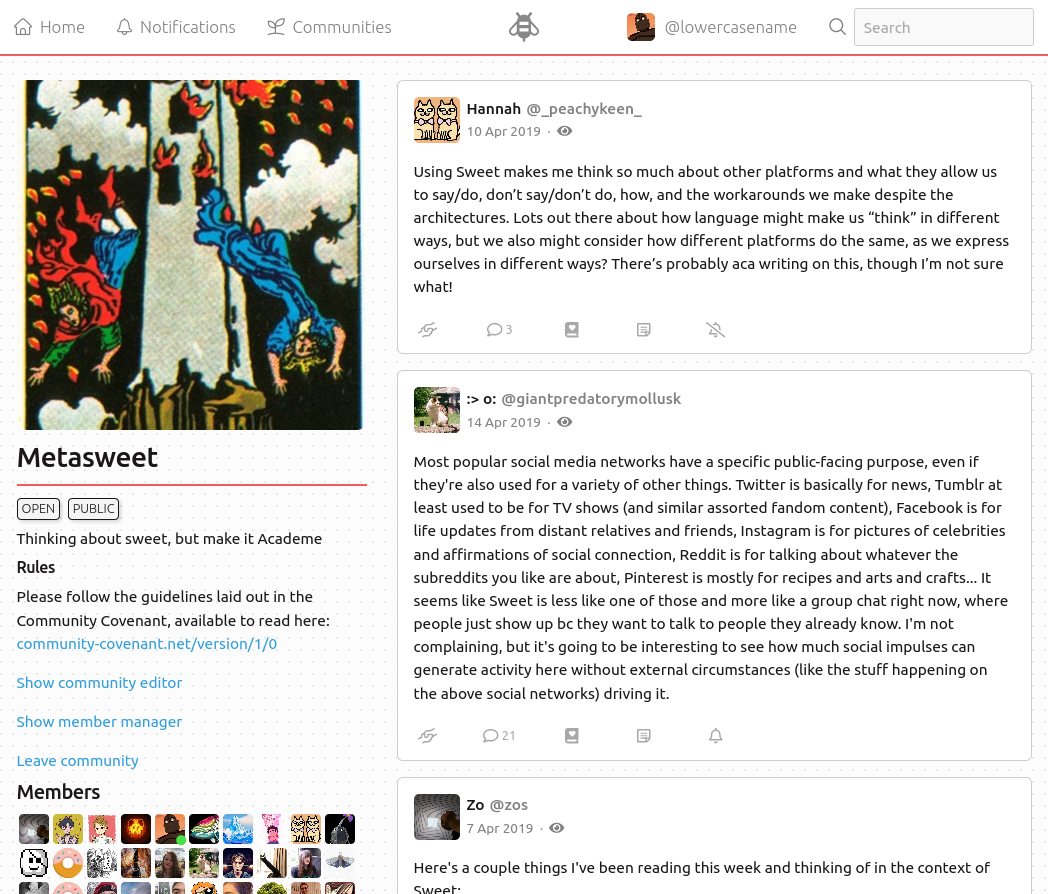
Because I had no idea what I was doing, Sweet was very poorly coded and riddled with bugs, but it also had a strong identity which encouraged certain kinds of people to stay and contribute. It was cute, cosy, ad-free, queer, and prioritised safety using tools like a whisper system where bad actors could be silently flagged. It didn't have metrics for likes or reactions, had a chronological feed, and members were encouraged to actively contribute ideas to Sweet's development. Sweet was a wonderful experiment and when I shut it down it was because the burden of moderation and upkeep of a deteriorating codebase became too much to bear on top of a full-time job.
It's been a few years since I shut down Sweet, and I miss it more and more each day. In this miserable historical moment, which might also be the crack in the wall of techocapitalism through which utopia emerges, I am increasingly certain of a couple of things:
- People need better ways to be social and commmunal together.
- There is not yet a perfect tool out there to enable communities that are safe, cosy, and energising.
- People may crave sociality - which is why they use the social tools of what my friend Kit reminds me is called the "Californian Ideology" - but they also deserve data sovereignty, privacy, and interoperability. None of these are what people look for when they look for somewhere to build a community - but these are the things that make that community work in the interests of its users, not capital.
- Creating communities in person is vital, but so is creating tele-communities - communities over long distances. This is the original promise of the Internet and it's still an incredible promise. As our enemies become more powerful and capable, we must also become more powerful and more capable, and creating communities which are open to everyone around the world and give those people sovereignty and control is one step in that direction.
- I can't stop coming up with new ideas for social networks.
Thus follows a shortlist of ideas for social networks I've had over the last few years. Almost all of these are bad. But in amongst them there is maybe a glimmer of utopian possibility for online community.
A social network built like an allotment. The whole network is a grid of 128 plots. Each plot is a possible user page for someone to write posts and share images. If all 128 plots are occupied, new users join a waiting list. Each user has to tend to their plot once every 7 days by posting something. If they don't, after a grace period, their plot gets composted and offered to the next person on the waiting list. But beneath that new person's posts, visitors can still see the compost of all previous people who tended this plot. There's no 'wall' or 'general feed' - visitors can visit individual plots and see what's growing there.
A social network for ten people for a week. People join a waiting list. When there are ten people on the list, they are all put in a tiny private chatroom for a week, where they can post, answer icebreaker questions, and get to know each other. After a week, the chatroom is deleted or archived.
A social wiki. People write posts, but others can then share and edit these posts. There are no comments, so edits to posts also need to incorporate their own comments. Posts drift further and further away from their original authorship, and further into something communal and shared.
A sea of tiny social networks, where one person with one account can take on different personas in different communities.
A social network called Twelve, where each user can have at most twelve followers and themselves follow at most twelve people. This is because twelve is an inherently funny number. Even funnier would be a social network where each user has to follow exactly twelve people before they're allowed to post anything.
A place combining a traditional feed for long form posting with a live 'firehose', IRC-style chat channel running alongside. Updates on the mundane charms and joys and woes of the day could go in the chat channel. Longer posts could go in the main feed. This would be a place for a small, cosy community, self-hostable but also offered as a hosted service for a small annual fee. All data could be easily exported and imported. This could be a place for an interest or hobby group (open to newcomers), or a private community of friends. Public communities could optionally feature in an open directory. This is my newest idea, and the one I'm most excited about.
If you want to help me build a better social network, reach out!